
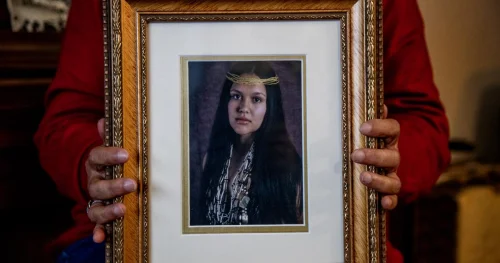
Missing Native American women crisis persists despite legislative reforms
Annual reports show 5,800 Indigenous females vanished last year with minimal media coverage

Approximately 5,800 Native American women and girls were reported missing in 2023, continuing a devastating trend that sees thousands of Indigenous females disappear annually with minimal public attention. The crisis affects Indigenous communities disproportionately, with federal data indicating 40% of sex trafficking victims identify as American Indian or Alaska Native women despite representing only 2.9% of the U.S. population.
Nearly three-quarters of missing Native American females reported last year were children, according to Representative Mike Simpson (R-Idaho), who chairs the House Interior and Environment Subcommittee on Appropriations. The scale of the problem has led to the acronym MMIP - "Missing or Murdered Indigenous Persons" - becoming commonplace in tribal communities and law enforcement circles.
Jurisdictional gaps hinder justice
Complex jurisdictional overlaps create significant barriers to investigating these cases. Crimes on reservations may fall under tribal police, Bureau of Indian Affairs, county sheriffs or FBI authority, creating what experts describe as a "Bermuda Triangle" of responsibility. Eugenia Charles-Newton, chair of the Navajo Nation's law and order committee, recounted her own experience of being beaten and raped for a week at age 17 without subsequent prosecution because authorities couldn't determine jurisdiction.
"Because I didn't know where I was being kept - where the shed was located - they could never identify the jurisdiction," Charles-Newton stated. "And the man - who I knew - ... I said his name - they never prosecuted him."
Legislative response falls short
Recent federal legislation aimed at addressing the crisis includes the Not Invisible Act of 2019, which established a commission focused on MMIP cases and human trafficking, and Savanna's Act - named for Savanna LaFontaine-Greywind, a 22-year-old murdered in 2017 while eight months pregnant. The 2020 law sought to standardize protocols and improve data collection.
Additionally, over $86 million in grants were distributed under the Violence Against Women Act last year to support survivors of domestic violence, sexual assault and trafficking. However, these efforts have yet to significantly impact the numbers, with approximately 5,700 Native women reported missing in 2016 and roughly 5,800 in 2023.
Data challenges compound problem
Official statistics likely undercount the true scale of the crisis, as Native women are frequently misidentified as Hispanic or categorized as "other" on official forms. An Associated Press investigation found that at the end of 2017, Native women were nearly doubly overrepresented in missing-person cases compared to their population percentage.
Some law enforcement agencies dispute the severity of the crisis, with the Salt Lake City Police Department contesting research suggesting 24 Indigenous women's deaths in their jurisdiction, claiming only 2 homicides out of 17 total deaths since 2008.
The Canadian National Inquiry into missing and murdered Indigenous women identified historical colonialism and systemic inequality as root causes rather than primarily jurisdictional failures, suggesting addressing underlying socioeconomic disparities may prove more effective than law enforcement reforms alone.
Leave your Comment
0 Comments